Warehouse Slotting Strategy: A Manager's Guide for 2026

A warehouse slotting strategy is the systematic process of assigning SKUs to specific storage locations based on pick velocity, product size and weight, and order affinity to minimize picker travel and reduce labor costs. This is not a layout preference or a one-time setup decision. It is a data-driven discipline that directly determines how fast your team picks, how accurately orders ship, and how safely workers move through the facility. Understanding what a warehouse slotting strategy involves, and how to execute one well, separates high-performing distribution operations from those constantly fighting inefficiency. The core methods include velocity-based ABC classification, affinity grouping, constraints-based placement, zone slotting, and dynamic slotting supported by a Warehouse Management System (WMS).
What is a warehouse slotting strategy and how does it work?
Warehouse slotting assigns SKUs to storage locations based on pick velocity, product size and weight, and affinity to minimize walking and handling. The strategy operates at two levels: macro-slotting, which covers zone-level decisions across the warehouse floor, and micro-slotting, which determines the exact bin or shelf position for each SKU. Both levels must align for the strategy to deliver measurable results.
The core logic is straightforward. Products picked most often belong closest to packing and dispatch areas. Products rarely touched belong in remote or elevated positions. Every meter a picker does not have to walk is a direct labor saving. Picker travel time accounts for up to 57% of total pick labor time, which means slotting decisions have an outsized impact on your cost per order.

Slotting also integrates with replenishment. Successful slotting balances velocity, size, weight, demand patterns, picking, and replenishment together as integrated processes. Treating them separately creates bottlenecks where prime pick locations run empty while replenishment staff struggle to keep pace.
What are the main slotting methods and how do they differ?
Each slotting method addresses a different operational priority. Most warehouses use a combination rather than a single approach.
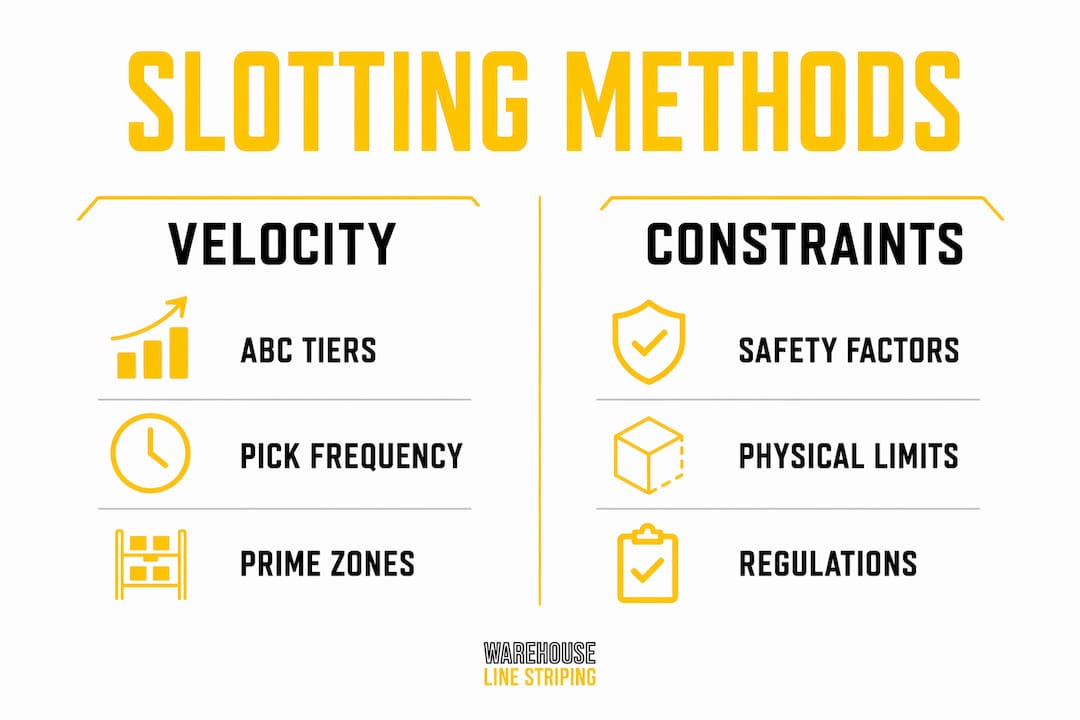
Velocity (ABC) slotting classifies SKUs into A, B, and C tiers by pick frequency. A-items go into prime “golden” zones near packing areas to reduce pick time and labor costs. B-items occupy mid-range positions. C-items, picked infrequently, go to the back or upper shelves. This is the most widely used method and the logical starting point for any slotting program.
Affinity grouping complements velocity by placing frequently co-ordered SKUs in adjacent locations. If customers routinely order product A with product B, placing them near each other cuts pick path distance for those orders. This method is particularly effective in e-commerce and B2C fulfillment where multi-line orders dominate.
Constraints-based slotting overrides velocity when physical or regulatory factors demand it. Heavy items go on low shelves, hazardous products in dedicated zones, and temperature-sensitive items in climate-controlled areas. These constraints protect worker safety and maintain regulatory compliance regardless of how fast a product moves.
Zone slotting divides the warehouse into specialized areas by product type, pick method, or equipment requirement. A facility might dedicate one zone to small-parcel picks and another to pallet-level picks, each with its own slotting rules.
Seasonal and event-based slotting repositions SKUs ahead of demand spikes. A retailer preparing for peak season moves high-demand items into prime positions before volume arrives, then returns them to standard locations afterward.
| Slotting method | Primary driver | Best suited for |
|---|---|---|
| Velocity (ABC) | Pick frequency | All warehouse types |
| Affinity grouping | Co-order patterns | E-commerce, B2C fulfillment |
| Constraints-based | Weight, safety, compliance | Hazmat, cold chain, heavy goods |
| Zone slotting | Equipment or pick method | Mixed-SKU distribution centers |
| Seasonal/event-based | Demand variability | Retail, 3PL, promotional goods |
Pro Tip: Run an affinity matrix on 90 days of order history before finalizing your ABC tiers. You will find co-ordered pairs that velocity data alone would never surface, and placing them together can cut pick path distance significantly on multi-line orders.
How does slotting improve operational efficiency and safety?
The efficiency gains from a well-executed slotting program are concrete and measurable. Proper slotting can reduce picker travel time by up to 55%, which translates directly into lower labor costs and higher throughput without adding headcount. For a facility running 500 picks per shift, that reduction compounds quickly across weeks and months.
Beyond speed, slotting reduces picking errors. When fast-moving SKUs are in predictable, clearly marked locations, pickers spend less time searching and less time correcting mistakes. Fewer errors mean fewer returns, fewer re-picks, and better customer satisfaction scores.
Ergonomics and worker safety are equally significant. Placing heavy or awkward SKUs at floor level or on low shelves reduces the risk of strain injuries. Forward pick locations near packing areas should have ergonomic height limits that prevent heavy or large SKUs from occupying prime positions even when those SKUs are high-velocity. Safety and speed are not competing priorities in a well-designed slot plan. They reinforce each other.
Clear floor markings that support pick paths amplify these gains by making zone boundaries and travel routes visible at floor level. Workers navigate faster and with fewer wrong turns when the physical environment matches the slotting plan.
What role does WMS technology play in slotting optimization?
A Warehouse Management System is the operational backbone of any dynamic slotting program. WMS tools track inventory location and movements, providing the real-time data needed for slotting optimization and replenishment management. Without that visibility, you are making placement decisions based on guesswork rather than actual pick patterns.
The specific functions a WMS provides for slotting include:
- Tracking SKU velocity by location and time period to identify tier changes
- Directing putaway to optimal slots based on current rules and available space
- Supporting random slotting by maintaining real-time location records so pickers always know where a product is
- Generating slotting recommendations through built-in algorithms or integration with dedicated slotting software
- Flagging SKUs whose velocity has shifted enough to warrant relocation
Random slotting requires real-time location control to avoid pick errors and inefficiencies. Without WMS support, random slotting loses its advantage entirely because pickers cannot reliably find products. This is why facilities attempting random or dynamic slotting without a WMS consistently underperform those using fixed slotting with manual tracking.
Without WMS visibility over product locations and movement through the warehouse, maintaining slotting benefits is difficult due to the lack of real-time data. The WMS does not just support slotting. It makes sustained slotting optimization possible.
Pro Tip: Before investing in dedicated slotting software, extract 6 months of pick data from your existing WMS and run a basic ABC analysis in a spreadsheet. Many facilities find that repositioning just their top 50 A-items produces measurable results before any software purchase is justified.
What are the best practices for implementing a slotting strategy?
Execution discipline separates slotting programs that deliver results from those that stall after the first wave of changes. Follow these steps to build a slotting program that holds up over time.
- Conduct a data analysis before touching a single product. Pull at least 90 days of order history and classify SKUs into A, B, and C velocity tiers. Build an affinity matrix to identify co-ordered pairs. Document physical constraints including weight, size, and hazard classification for every SKU.
- Define your physical zones and golden pick areas. Map the warehouse floor and identify prime locations closest to packing and dispatch. Set ergonomic height limits for those positions. Establish dedicated zones for hazardous materials, temperature-sensitive goods, and oversized items. A distribution center floor layout plan gives you the spatial framework your slot assignments need.
- Execute in phases, starting with your top movers. Relocate your top 100 movers first, evaluate the impact, then proceed with lower tiers to avoid disrupting workflow. Trying to reslot an entire warehouse at once creates confusion, pick errors, and staff frustration that erode the gains you are trying to achieve.
- Set replenishment rules tied to slot assignments. Each prime pick face needs a defined replenishment trigger and a source location. Slotting and replenishment must work together. A perfectly slotted A-item that runs empty during peak hours delivers no benefit.
- Schedule regular slot reviews. Quarterly review cycles keep slotting aligned with business needs as demand patterns shift. Seasonal products, new SKU introductions, and promotional events all change velocity tiers. A slot plan that was accurate six months ago may be actively hurting efficiency today.
- Train staff and track impact metrics. Measure picks per hour, travel distance per pick, and error rates before and after each slotting phase. Involve floor staff in identifying problem slots. They see inefficiencies that data alone does not capture.
How slotting strategies vary by warehouse type and inventory mix
No two warehouses slot identically. The right approach depends on your product mix, order profiles, and operational model.
E-commerce and B2C fulfillment operations handle high volumes of small, multi-line orders. Affinity grouping and velocity slotting work together here, with prime locations reserved for the SKUs that appear most often in the same order. Pick path optimization matters more than in pallet-level operations because pickers touch dozens of locations per shift.
3PL warehouses manage inventory for multiple clients, each with different velocity profiles and physical constraints. Zone slotting by client or product category keeps operations organized and prevents cross-contamination of picking logic. Warehouse capacity utilization planning becomes critical when space is shared across accounts.
Manufacturing and industrial warehouses often deal with heavy components, hazardous materials, and strict compliance requirements. Constraints-based slotting takes priority here. A high-velocity item that weighs 80 pounds does not belong at shoulder height regardless of its ABC classification.
Seasonal retail distribution centers require a slotting calendar. Products that rank as C-items in January may become A-items in November. Dynamic slotting continuously adjusts product placement based on real-time demand and order data, making it the right model for operations with significant seasonal variability.
The common thread across all warehouse types is that slotting optimization is an ongoing discipline, not a one-time project. Inventory popularity and seasonal demand constantly change, making WMS-driven recommendations necessary for sustained efficiency.
Key takeaways
A warehouse slotting strategy delivers measurable efficiency gains only when velocity data, physical constraints, WMS support, and phased execution are treated as a single integrated system rather than separate tasks.
| Point | Details |
|---|---|
| Slotting reduces travel time | Proper slot assignments cut picker travel time by up to 55%, directly lowering labor costs. |
| ABC velocity is the foundation | Classify SKUs into A, B, and C tiers first, then layer in affinity and constraints data. |
| WMS is non-negotiable for dynamic slotting | Random and dynamic slotting lose their advantage entirely without real-time WMS location tracking. |
| Phase your execution | Relocate top movers first, measure results, then proceed to lower tiers to protect workflow. |
| Slotting requires ongoing review | Quarterly updates to velocity tiers keep slot assignments aligned as demand and product mix evolve. |
Why most slotting programs underdeliver in practice
The most common failure I see is treating slotting as a velocity-only exercise. Teams run an ABC analysis, move their A-items to the front, and call it done. Six months later, pick rates have improved modestly but ergonomic injury reports have gone up because nobody accounted for the 40-pound A-items now sitting at shoulder height. Velocity data tells you what moves fast. It does not tell you what belongs in a prime location.
The second failure is skipping the measurement window. Slotting changes disrupt familiar pick paths before they improve them. Pickers slow down while they learn new locations. If you measure performance in the first two weeks after a reslot, the numbers will look worse, not better. You need a defined window of four to six weeks before drawing conclusions. Teams that skip this step often reverse good slotting decisions because they misread the temporary dip as a permanent outcome.
The third issue is WMS integration. Many facilities have a WMS but are not using it to drive slotting decisions. The data is there. The pick history, the location records, the velocity reports. But nobody has connected those outputs to a formal slotting review process. The WMS becomes a transaction system instead of an optimization engine.
My practical advice: start with your top 50 A-items, apply both velocity and constraint filters, execute the moves in a single weekend shift, and measure for six weeks. That controlled experiment will tell you more about your facility’s slotting potential than any consultant’s report.
— ET
How floor markings make your slotting strategy visible on the ground
A slotting strategy only works when pickers can navigate it accurately at speed. Floor markings translate your slot plan into a physical reality that workers can follow without stopping to check a screen. Warehouse Line Striping has completed over 10,000 projects across warehouses and distribution centers nationwide, applying OSHA-compliant, high-durability epoxy markings that last 3 to 7 years. From pallet storage grid markings that define precise slot boundaries to floor marking systems for inventory flow that guide pick paths through your golden zones, Warehouse Line Striping delivers the physical infrastructure your slotting program needs to perform. Contact Warehouse Line Striping to get a customized floor marking plan built around your slotting layout.
FAQ
What is a warehouse slotting strategy in simple terms?
A warehouse slotting strategy is the process of assigning each SKU to a specific storage location based on how often it is picked, its physical characteristics, and its relationship to other products. The goal is to minimize the distance pickers travel and reduce the time it takes to fulfill each order.
How often should you review and update your slotting plan?
Quarterly review cycles are the standard recommendation, with additional reviews triggered by seasonal demand shifts, new product introductions, or significant changes in order profiles. Slotting is an ongoing discipline, not a one-time setup.
Can you implement slotting without a WMS?
Fixed slotting with permanent, labeled locations can be managed without a WMS. Random and dynamic slotting cannot. Without WMS visibility over real-time product locations, random slotting creates pick errors that eliminate any efficiency gains.
What is the difference between macro-slotting and micro-slotting?
Macro-slotting refers to zone-level decisions across the warehouse, such as which product categories belong in which areas. Micro-slotting determines the exact bin, shelf, or pallet position for each individual SKU within those zones. Both levels must align for the strategy to work.
Which slotting method delivers the fastest results?
Velocity-based ABC slotting delivers the fastest measurable results because it directly addresses the largest source of wasted pick time. Moving your top A-items into prime locations near packing areas produces pick time reductions that are visible within weeks of implementation.