
Warehouse Capacity Utilization Plan: A Manager's Guide
A warehouse capacity utilization plan is a structured framework that defines how to measure, monitor, and optimize your facility’s storage and operational space to hit target efficiency rates while preventing costly bottlenecks. Most operations directors treat floor square footage as the primary metric, which is the first and most expensive mistake in warehouse capacity planning. This guide covers the full picture: how to calculate true cubic utilization, what the industry benchmarks actually mean, when to trigger expansion, and how to squeeze more throughput from the space you already have.
What is a warehouse capacity utilization plan?
A warehouse capacity utilization plan is a documented strategy that tracks how much of your available storage and operational space is actively in use at any given time. It combines measurement methodology, utilization targets, expansion triggers, and optimization tactics into a single operational framework. The plan answers three questions: how much space do you have, how much are you using, and what do you do when those numbers diverge.
The plan matters because space is never free. Every square foot of warehouse carries overhead costs including rent, utilities, insurance, and labor. When you operate without a formal capacity utilization strategy, you are either wasting money on underused space or throttling throughput by running too hot. Both conditions hurt your bottom line in measurable ways.

The core components of any solid plan include a baseline capacity audit, a utilization rate formula, defined thresholds for action, and a review cadence. Without all four, you have a snapshot rather than a management tool. Warehouse management systems (WMS) like Manhattan Associates, Blue Yonder, and Körber Supply Chain can automate utilization tracking once the baseline is established.
How to measure warehouse capacity and calculate utilization rates
Accurate measurement is the foundation of the entire plan. Most managers default to gross floor area, but true warehouse capacity is three-dimensional. You need cubic feet, not square feet.
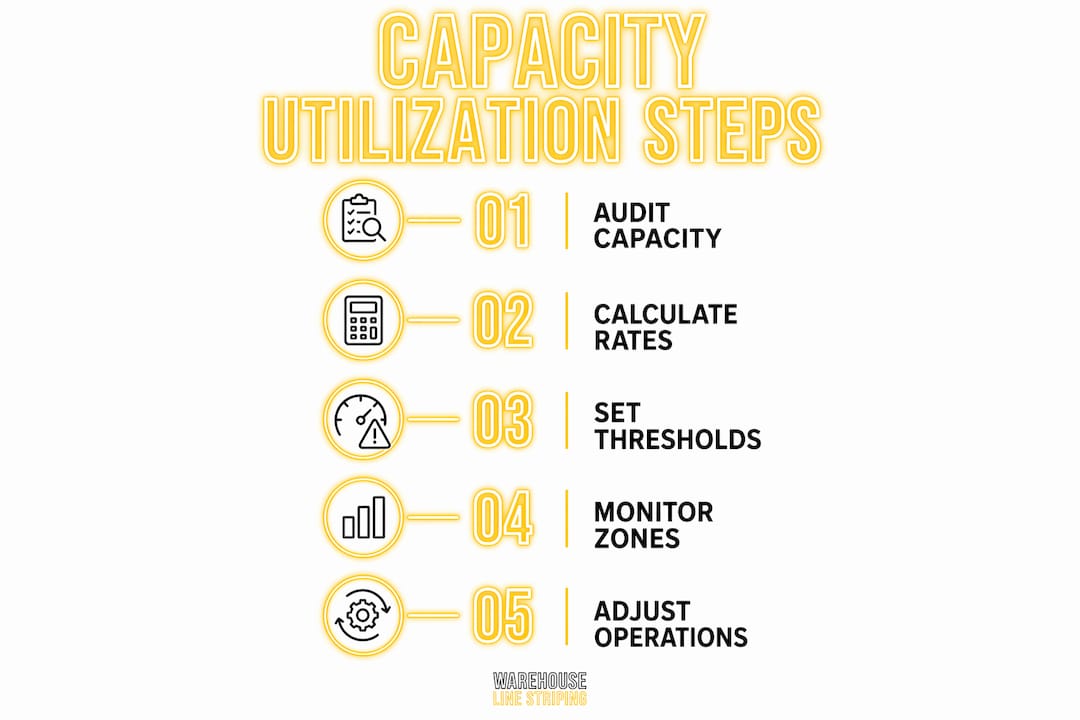
Follow these steps to calculate your usable capacity:
- Measure gross floor area. Start with the total interior square footage of the facility.
- Subtract non-storage zones. Remove office space, restrooms, charging stations, staging areas, and any fixed equipment footprints. What remains is your net storage floor area.
- Determine clear stacking height. This is not your ceiling height. It is the distance from the floor to the lowest obstruction, whether that is a sprinkler head, HVAC duct, or lighting fixture. Clear height vs. ceiling height is a critical distinction that directly affects your cubic capacity calculation.
- Calculate total cubic storage capacity. Multiply net storage floor area by clear stacking height.
- Measure current inventory cubic volume. Sum the cubic dimensions of all stored inventory in its current configuration.
- Apply the utilization formula. The standard calculation is (Inventory Cubic Volume ÷ Total Cubic Storage Capacity) × 100. The result is your utilization percentage.
Pro Tip: Never rely on facility-wide averages alone. A warehouse showing 78% aggregate utilization can still have a receiving zone running at 95% while bulk storage sits at 60%. Zone-level measurement exposes the real bottlenecks that aggregate numbers hide.
Here is a simplified example to make the formula concrete:
| Metric | Example Value |
|---|---|
| Net storage floor area | 40,000 sq ft |
| Clear stacking height | 24 ft |
| Total cubic capacity | 960,000 cu ft |
| Current inventory volume | 768,000 cu ft |
| Utilization rate | 80% |
Running this calculation by zone, not just facility-wide, gives you the granular data needed to make targeted decisions about slotting, layout changes, and expansion timing.
What is the ideal warehouse utilization rate?
Optimal warehouse utilization falls between 80% and 85%. This range is the industry benchmark because it balances space efficiency with the operational flexibility needed to receive new inventory, handle returns, and absorb demand spikes without grinding workflows to a halt.
The consequences of pushing above this range are concrete and immediate:
- Congestion in pick aisles slows order fulfillment and raises labor cost per unit
- Restocking becomes difficult when put-away locations are blocked or unavailable
- Safety risks increase as workers navigate tighter spaces with forklifts and pallet jacks
- Operating above 85 to 90% utilization consistently leads to measurable productivity losses and elevated error rates
Low utilization carries its own costs, but the analysis is more nuanced. Operating below 70% typically signals wasted overhead and underused assets. However, not all low utilization is a problem.
“Low utilization isn’t always negative; it sometimes represents strategic buffer capacity to handle demand spikes and prevent operational disruption during peak seasons.”
A distribution center that deliberately holds 20% buffer capacity ahead of Q4 peak season is making a smart financial decision, not an inefficient one. The distinction between strategic buffer capacity and operational waste is one of the most important judgments a warehouse manager makes. Your capacity utilization strategy should define which zones carry buffer capacity by design and which zones are targets for improvement.
When and how to expand warehouse capacity
Expansion decisions require formal triggers, not gut instinct. Capacity expansion is typically triggered when utilization exceeds 85% for two consecutive quarters or when capacity constraints cause a measurable decline in service levels, such as a greater than 10% drop in order acceptance rates.
The reason for the two-quarter rule is important. A single quarter above threshold could reflect a seasonal spike. Two consecutive quarters above threshold signals a structural capacity problem that will not self-correct.
Once a trigger fires, you have three strategic options for expansion:
| Strategy | Timing | Risk Profile | Best For |
|---|---|---|---|
| Lead | Invest before demand arrives | Higher capital risk, lower operational risk | High-confidence demand forecasts |
| Lag | Expand only after demand is proven | Lower capital risk, higher service risk | Uncertain or volatile demand |
| Match | Incremental adjustments aligned to demand signals | Moderate risk on both sides | Most warehouse operations |
Choosing the wrong expansion strategy based on uncertain demand can harm margins significantly. A lead strategy in a softening market locks capital into space you cannot fill. A lag strategy in a growth market forces you into reactive, expensive short-term fixes like off-site storage contracts at premium rates.
Pro Tip: Facility expansion lead times range from 18 to 36 months. If you wait until utilization hits 90% to start the planning process, you will spend 18 months managing an overloaded facility while your expansion is still under construction. Start the process at 80%.
Practical expansion methods short of a full facility build include adding shifts to spread throughput across more hours, deploying mobile shelving systems to increase storage density, and reconfiguring distribution center floor zones to recover underused areas. These tactical moves buy time but are not substitutes for a formal capacity plan.
Operational tactics to maximize utilization without expanding
The most cost-effective capacity gains come from optimizing what you already have. These tactics apply regardless of facility size and can be implemented without capital expenditure.
Slotting optimization is the single highest-return tactic available to most operations. Place fast-moving SKUs in the most accessible pick locations, close to shipping docks and at ergonomic heights. Slow-moving and seasonal inventory belongs in harder-to-reach zones. Proper slotting reduces travel time, improves pick rates, and frees up prime space for high-velocity product.
Vertical storage is consistently underused. Most warehouses use 40 to 60% of their available clear height. Adding a mezzanine level, taller racking systems, or high-bay shelving can double storage capacity without touching the building footprint. Pair vertical expansion with pallet storage grid markings to keep inventory organized and accessible at every level.
Aisle width reduction recovers floor space that is currently allocated to travel rather than storage. Switching from standard 12-foot aisles to narrow-aisle configurations with reach trucks can recover 15 to 20% of floor area for storage. Review aisle width compliance standards before making changes to confirm equipment compatibility and OSHA requirements.
Dwell time reduction addresses inventory that occupies space longer than necessary. Slow-moving inventory, excess safety stock, and obsolete SKUs all consume cubic capacity without generating throughput. A quarterly inventory audit that identifies and removes dead stock is one of the fastest ways to recover usable space.
WMS utilization tracking closes the loop. Systems like SAP Extended Warehouse Management, Oracle Warehouse Management, and Deposco provide real-time utilization data by zone, allowing managers to respond to emerging bottlenecks before they affect service levels. Facility-wide averages can be misleading; localized bottlenecks in high-velocity zones throttle overall throughput even when aggregate utilization looks healthy.
Key takeaways
A warehouse capacity utilization plan works when it combines accurate cubic measurement, zone-level tracking, defined expansion triggers, and targeted optimization tactics applied before utilization reaches critical thresholds.
| Point | Details |
|---|---|
| Measure in cubic feet | Calculate usable cubic capacity using net floor area multiplied by clear stacking height, not gross square footage. |
| Target 80 to 85% utilization | This range balances space efficiency with the operational flexibility needed to absorb demand variability. |
| Set formal expansion triggers | Act when utilization exceeds 85% for two consecutive quarters, not when the facility is already at capacity. |
| Optimize before expanding | Slotting, vertical storage, and aisle reconfiguration often recover 15 to 20% of capacity without capital investment. |
| Track by zone, not just facility-wide | Aggregate utilization numbers hide bottlenecks; zone-level data drives targeted decisions. |
Why most capacity plans fail before they start
The most common failure I see is treating a warehouse capacity utilization plan as a one-time audit rather than an ongoing management discipline. A team runs the numbers, produces a report, files it, and returns to managing by feel. Six months later, the facility is over capacity and the report is irrelevant.
The second failure is fixating on the facility-wide utilization number as if it were the only metric that matters. I have worked with operations running at a comfortable 78% aggregate utilization that were functionally broken because one receiving zone was perpetually at 95% and creating a ripple effect across every downstream process. Bottleneck optimization improves overall system throughput far more than pushing every zone toward the same target.
The third failure is confusing a capital investment decision with an operational one. Managers sometimes push utilization to 90% or higher because they are reluctant to request budget for expansion. The result is a facility that runs hot, burns out staff, and generates service failures that cost far more than the expansion would have. Reactive expansion after utilization hits hard limits is consistently more expensive than proactive planning.
The advice I give every operations director is this: build your plan around the constraint, not the average. Find the zone or process that limits your throughput first, fix that, and then reassess. The 80 to 85% benchmark is a guide, not a goal. Your goal is a facility that can absorb the next demand spike without breaking.
— ET
How Warehouse Line Striping supports your capacity plan
A capacity utilization plan tells you where your space is going. Warehouse Line Striping helps you reclaim it. Precise floor markings define pick paths, storage grids, staging zones, and traffic lanes so every square foot of your facility works as intended. When floor layouts are clearly marked, workers follow optimized routes, inventory lands in designated locations, and bottlenecks caused by ambiguous zones disappear. Warehouse Line Striping has completed over 10,000 projects nationwide, using industrial-grade epoxy coatings that last 3 to 7 years and meet OSHA compliance standards. If your current layout no longer matches your capacity plan, floor marking solutions from Warehouse Line Striping can realign your physical space with your operational strategy.
FAQ
What is a warehouse capacity utilization plan?
A warehouse capacity utilization plan is a structured framework for measuring, monitoring, and optimizing how much of a facility’s storage and operational space is actively in use. It includes a utilization formula, target thresholds, expansion triggers, and optimization tactics.
How do you calculate warehouse utilization rate?
Divide your current inventory cubic volume by your total cubic storage capacity, then multiply by 100. Total cubic storage capacity equals net storage floor area multiplied by clear stacking height, excluding non-storage zones and overhead obstructions.
What is the ideal warehouse utilization percentage?
The industry benchmark for healthy warehouse utilization is 80 to 85%. Operating above 85% consistently leads to congestion and productivity losses, while operating below 70% typically signals wasted overhead costs.
When should a warehouse trigger a capacity expansion?
A formal expansion trigger fires when utilization exceeds 85% for two consecutive quarters or when capacity constraints cause a measurable decline in service levels. Because facility expansion lead times range from 18 to 36 months, planning must begin well before utilization reaches critical levels.
What is the difference between lead, lag, and match capacity strategies?
Lead strategy invests in capacity ahead of demand and carries higher capital risk. Lag strategy expands only after demand is confirmed and risks service failures during growth. Match strategy makes incremental adjustments aligned to demand signals and suits most warehouse operations facing moderate demand uncertainty.