How Floor Markings Support Lean Operations

Floor markings are visual management tools that delineate work areas, define pathways, and standardize storage locations to support lean operations by reducing ambiguity and directing behavior without verbal instruction. In lean manufacturing floor design, these markings function as the physical layer of a 5S system, making the right way to work the obvious way to work. A 2026 meta-analysis of 40 cueing studies found that visual cue interventions significantly improve task outcomes, confirming what lean practitioners have observed for decades. When floor markings are designed with intent and maintained with discipline, they become one of the highest-leverage tools in your operational toolkit.
How floor markings support lean operations through visual management
Floor markings earn their place in lean operations through their connection to 5S, specifically the “Set in Order” and “Standardize” phases. These two phases demand that every item, pallet, cart, and workstation has a fixed, labeled home. Markings make those homes visible without requiring anyone to ask, search, or interpret. That reduction in cognitive load is exactly what lean visual management is designed to achieve.
The critical distinction most facilities miss is this: markings without Standardized Work become cosmetic within weeks. A yellow box on the floor means nothing if no one has defined what belongs there, how full it can get, and who is responsible for maintaining it. Lean TPS is direct on this point. Without Standardized Work governing the intent behind each marking, 5S becomes subjective and fragile, and areas drift back to disorder.
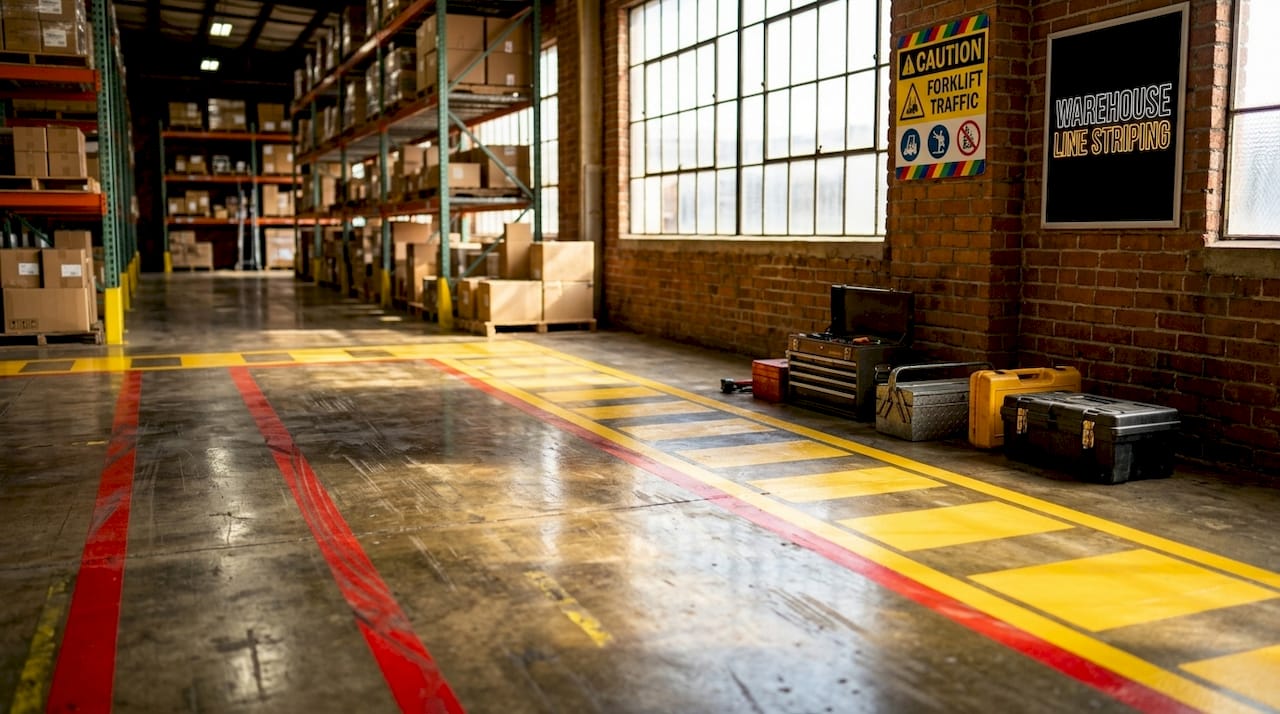
The benefits of floor markings materialize when they reflect decisions already made about workflow. Fixed locations for WIP carts eliminate the daily shuffle of “where did that go?” Shadow boards and outlined storage locations make missing tools immediately obvious, reducing search time and building accountability into the physical environment. These are not decorative touches. They are behavioral controls embedded in the floor.
Daily audits and leadership walk-throughs reinforce the system. When a supervisor can see at a glance that a staging zone is overflowing its marked boundary, the marking becomes a conversation starter and a performance signal, not just a painted line.
- Define ownership for every marked zone before installation
- Tie each marking to a specific step in a standardized work document
- Schedule weekly audits to catch drift before it becomes habit
- Use color consistently so operators build intuitive recognition over time
Pro Tip: Before marking a single square foot of floor, map your current-state workflow and identify the three zones with the most daily confusion. Mark those first. The improvement will be visible within days and will build organizational buy-in for the broader rollout.
What safety benefits do floor markings provide in lean environments?
Safety is not a secondary benefit of floor markings. It is a primary function, and in lean environments where forklifts, pedestrians, and moving equipment share space, the separation of traffic types is a life-safety issue. OSHA 29 CFR 1910.22 mandates that permanent aisles and passageways be appropriately marked, and worn or unclear markings must be maintained or replaced to remain compliant.
Color coding aligned with ANSI standards creates an intuitive visual language across your facility. Yellow marks walkways, red signals hazard zones or defective goods, green designates finished goods, and orange or white can indicate work-in-process areas. New employees learn the system faster. Experienced operators stop making exceptions because the floor itself communicates the rule.
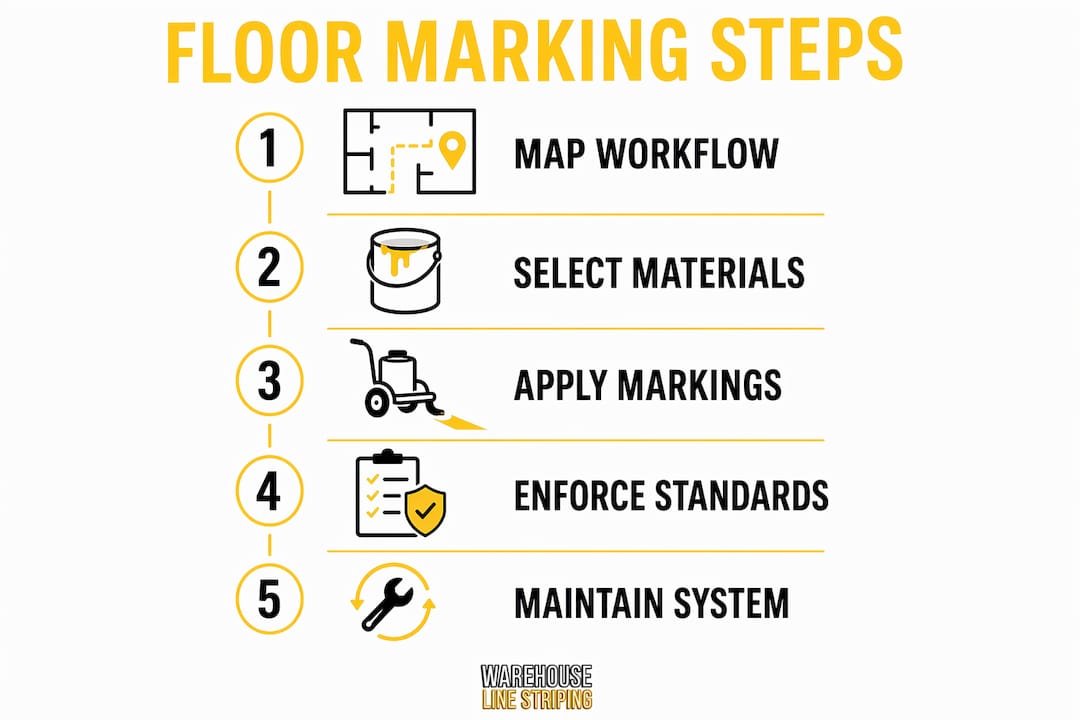
Forklift and pedestrian conflicts are among the most preventable causes of serious injury in warehouse and distribution environments. High-visibility crosswalks and directional arrows, recommended by both OSHA and ANSI, delineate safe pathways and reduce bottlenecks at intersections. That means fewer near-misses, less stop-and-go traffic, and a measurable reduction in collision risk. Pairing floor markings with slip and fall prevention strategies creates a layered safety approach that addresses both traffic and surface hazards.
Maintaining visibility is not optional. Faded markings are worse than no markings in some cases because operators assume the guidance is still valid and act on incomplete information. A systematic replacement schedule, tied to your facility’s maintenance calendar, keeps the safety layer intact.
Key safety applications for floor markings in lean facilities:
- Pedestrian walkways separated from forklift travel lanes
- Hazard zone boundaries around machinery, electrical panels, and loading docks
- Directional arrows at intersections and high-traffic corridors
- Clearly marked emergency exit paths and fire equipment locations
- Crossing zones with high-contrast colors at forklift and pedestrian intersections
How do material choices affect marking durability and system design?
Material selection determines whether your floor marking system lasts three months or three years. Paint is the most common choice and the most frequently regretted one. Standard floor paint chips, fades under forklift traffic, and requires full reapplication when it fails. Industrial epoxy coatings, by contrast, bond to the concrete substrate and resist abrasion, chemicals, and heavy equipment loads. Warehouse Line Striping’s epoxy-based markings carry a service life of three to seven years under normal industrial conditions, which is the difference between a quarterly maintenance headache and a set-it-and-govern-it system.
| Material | Durability | Best use case | Replacement ease |
|---|---|---|---|
| Standard floor paint | 3 to 12 months | Low-traffic areas, temporary zones | Easy but frequent |
| Industrial epoxy coating | 3 to 7 years | High-traffic aisles, forklift lanes | Requires professional removal |
| Floor marking tape | 6 to 18 months | Flexible layouts, pilot programs | Very easy, no tools needed |
| Industrial decals | 1 to 3 years | Symbols, icons, directional cues | Moderate, heat gun removal |
Marking degradation does not just create a visual problem. It creates a safety and lean management problem. When a marking fades, operators begin interpreting its boundary subjectively. That subjectivity introduces variance, and variance is the enemy of lean. MSC Industrial Supply characterizes floor markings as behavioral controls that require holistic design and ongoing maintenance, not isolated fixes applied reactively.
System design must account for real-world conditions before the first line is drawn. Wet zones near wash-down areas need non-slip coatings. High-glare lighting requires high-contrast color choices. Areas with heavy pallet jack traffic need wider lane markings to remain legible after repeated wheel contact. Poor system planning leads to patchwork fixes, overlapping markings, and a floor that communicates confusion instead of clarity.
Pro Tip: Use floor marking tape for your pilot phase in any new area. Tape lets you test placement, refine boundaries based on actual workflow observation, and confirm the design before committing to epoxy. Once the layout is validated, apply the permanent coating over the proven design.
Practical steps for implementing floor markings to support lean goals
Implementation succeeds when it follows a deliberate sequence rather than a facility-wide rollout done all at once. Starting with your highest-chaos zones, typically receiving docks, buffer areas, and staging lanes, gives you a contained test environment and produces visible results fast. Marking chaotic zones first and observing results for several weeks before expanding is the approach recommended by lean implementation specialists at Tagatic. That observation period is not optional. It is where you learn whether your design assumptions match actual operator behavior.
Follow this sequence for a structured rollout:
- Map current-state workflow in the target area, noting all movement paths, storage points, and handoff locations
- Identify ambiguities where operators make different decisions about placement or routing
- Define the standardized answer to each ambiguity and document it in a work instruction
- Design markings that reflect those decisions, using color coding consistent with your facility-wide convention
- Apply markings in the pilot zone and train all affected operators on the system
- Observe for two to four weeks, tracking any deviations or workarounds
- Refine the design based on observations, then expand to adjacent zones
Color coding rules must be written down and communicated, not assumed. A consistent color convention for yellow walkways, red hazard zones, and green finished goods areas creates an intuitive visual language that new employees can learn in a single orientation session. Post the color key at facility entrances and in team meeting areas so the reference is always accessible.
Shadowing and outlined storage locations extend the system beyond lanes and aisles. When every tool, cart, and container has an outlined home on the floor or on a shadow board, missing items become immediately visible. That visibility is what drives accountability. You can reference the pallet storage grid guide from Warehouse Line Striping for specific layout patterns that apply this principle to high-density storage environments.
Link every marking to a continuous improvement cycle. When a marking is consistently violated or worked around, that is data. It means either the marking is wrong or the standardized work needs revision. Treat both as improvement opportunities, not compliance failures.
Key takeaways
Floor markings work in lean operations because they make the correct behavior the default behavior, removing the need for interpretation, instruction, or supervision at the point of work.
| Point | Details |
|---|---|
| Tie markings to standardized work | Markings without governing work instructions drift into subjective use within weeks. |
| Start in high-chaos zones | Pilot in receiving or staging areas to validate design before facility-wide rollout. |
| Match material to traffic conditions | Use industrial epoxy for permanent high-traffic lanes and tape for pilot or flexible zones. |
| Color coding requires documentation | Write and post your color convention so all operators, including new hires, learn it consistently. |
| Audit and replace proactively | Faded markings introduce variance. Schedule replacements before degradation undermines the system. |
Why floor markings fail more often than they should
The most common failure mode I see in lean floor marking programs is not poor materials or bad design. It is the absence of governance after installation. A facility invests in a well-designed marking system, operators follow it for the first few months, and then gradually the markings stop matching reality. Pallets get placed outside their zones. Aisles get used as temporary storage. Nobody updates the markings when a workflow changes. Within a year, the floor communicates a process that no longer exists.
This happens because floor markings are treated as a project with an end date rather than a system with an owner. Every marked zone needs a named owner who is responsible for its condition and accuracy. That owner participates in layout decisions, flags when the marking no longer reflects the actual process, and escalates when drift becomes habitual. Without that ownership structure, even the best epoxy coating becomes irrelevant.
Leadership engagement is the other variable that separates facilities where markings work from those where they become background noise. When supervisors and managers use markings as reference points during walk-throughs, asking “why is this pallet outside its zone?” rather than ignoring it, the markings carry authority. When leadership walks past violations without comment, operators learn that the floor is advisory, not mandatory.
The facilities I have seen get the most from their floor marking investments treat the floor as a living document. They update markings when workflows change, retire zones that no longer serve a purpose, and use the floor layout best practices developed for high-volume environments as a reference for continuous refinement. That discipline is what separates a lean floor from a decorated one.
— ET
Get precision floor markings built for lean operations
Warehouse Line Striping designs and installs floor marking systems for warehouses, distribution centers, and industrial facilities across the country, with over 10,000 completed projects behind every recommendation. Their OSHA-compliant, industrial-grade epoxy coatings last three to seven years under heavy operational conditions, eliminating the cycle of reactive repainting that undermines lean discipline. Whether you need pallet storage grid markings for high-density storage or a complete staging area workflow that supports your lean flow, Warehouse Line Striping delivers customized layouts with minimal disruption to your operations. Contact their team to schedule a facility assessment and get a marking system that works as hard as your team does.
FAQ
How do floor markings support lean operations?
Floor markings support lean operations by creating fixed, visible boundaries for storage, pathways, and work zones that eliminate ambiguity and reduce the need for verbal instruction. They function as the physical layer of a 5S visual management system, making the correct placement and routing the default behavior for every operator.
What OSHA requirements apply to floor markings in warehouses?
OSHA 29 CFR 1910.22 requires that permanent aisles and passageways be appropriately marked and that worn or unclear markings be maintained or replaced. Facilities must keep markings visible and legible to remain compliant and protect pedestrian and vehicle safety.
What is the best material for floor markings in high-traffic facilities?
Industrial epoxy coatings are the most durable option for high-traffic aisles and forklift lanes, with a service life of three to seven years. Floor marking tape works well for pilot programs or flexible layouts where zone boundaries may change during the design phase.
Why do floor marking systems fail over time?
Floor marking systems fail when they lack governance through standardized work and named zone ownership. Without regular audits and leadership reinforcement, markings drift from actual workflows and operators begin treating them as suggestions rather than operational standards.
How should color coding be used in a lean floor marking system?
Color coding should follow a documented facility-wide convention, typically yellow for pedestrian walkways, red for hazard zones, and green for finished goods areas. Posting the color key at facility entrances and in team areas gives all operators, including new hires, a consistent reference for understanding placement and flow.